
Applications
• Energy Storage Devices
- Electrolyzers
The splitting of water into its hydrogen and oxygen components is a familiar high-school experiment. In this experiment, one connects a nine-volt battery to two sharpened lead pencils and places the pencils into a water solution to which has been added common table salt. Gas evolves at both electrodes. If one adds a universal pH dye, a different color appears at each electrode illustrating the pH difference at each electrode.
Most commercial electrolyzers split water either using an alkaline cell somewhat similar to that described above or a proton exchange membrane fuel cell running in reverse. The later uses a nafion membrane to separate the anode and cathode. If the anode and cathode compartments are separated, one can store both the hydrogen and oxygen as by-product gases. This hydrogen can be used in energy storage systems.
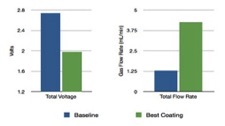
Our thin-film oxide coatings act to lower the electrical potential required splitting the water. As well, we produce more oxygen and hydrogen per unit surface area of electrode. At this moment, we are making alkaline type bi-polar electrolyzers where we coat stainless steel plates as our anodes and cathodes.
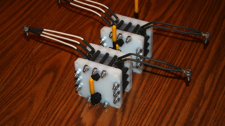
A picture of these electrolyzers is shown as well as the improved efficiency resulting from our coatings. We have been working with the city of Beloit to employ these electrolyzers as hydrogen on demand systems whereby both the hydrogen and oxygen are delivered to the intake air inlet of gasoline and diesel vehicles upon starting the engine. In these systems, no hydrogen is stored on board the vehicle but is only produced as needed. These systems result in improved mileage and lower emissions. A photo of one of these devices in a dodge truck best illustrates the installation of this device.