
Synthesis of Materials
• Gelation
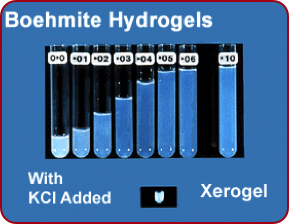
Since solvent is removed during the coating process, thin-films typically form gels upon drying. This process provides another option for controlling the structure of these materials. By altering the pH of the suspension or changing ionic strength and nature of the ion we control porosity. The figure at right shows the effect of KCl salt additions on boehmite hydrogels. With larger concentrations of chloride ions we obtain higher gelling volumes. If we choose to make membrane materials, we wish to achieve a random close-packed structure. If we wish to produce catalytic materials – we may prefer a more open system. Porosity can be varied between 30 and 70%. However, it should be cautioned that higher porosity materials have less strength.
Figure taken from Dr. Mary Gieselman (1990 PhD thesis)